Technical solutions for water, soil, biology, irrigation performance and treatment applications.
Wastewater and sludge treatment

EcoSystem Plus

Evaluate treatment changes against process stability, operator workload and full operating cost. EcoSystem Plus supports oxygen transfer, organic-waste breakdown and sludge management in wastewater treatment. Its aerobic-treatment and anaerobic-digestion applications have different dosing and monitoring requirements, matched to the process and incoming load.

Benefits

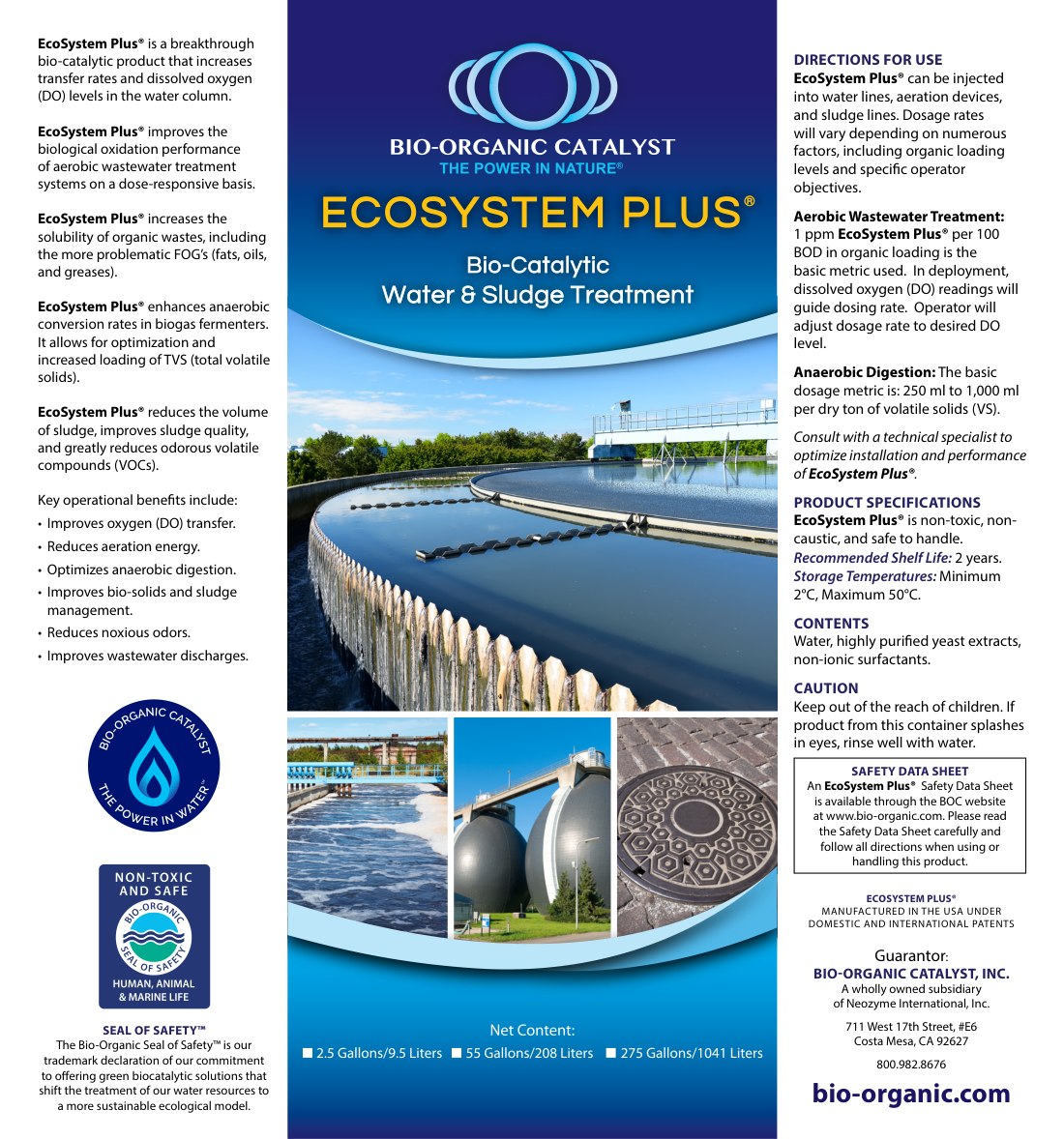
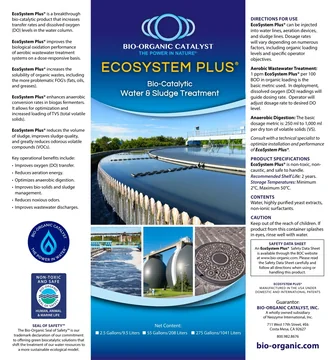
  • Form oxygen-carrying microbubbles that improve oxygen transfer in aerated wastewater
  • Support biological oxidation of organic loading
  • Improve organic-waste solubility, including FOG
  • Support organic-solids conversion in anaerobic digestion
  • Help manage sludge, biosolids and odors
  • Support lower aeration energy use where conditions allow

How it fits a program

In an aerated basin, EcoSystem Plus promotes the formation of oxygen-carrying microbubbles that help transfer oxygen from the air into the water. That can raise dissolved oxygen for the microbes that break down organic waste.

EcoSystem Plus also helps make organic waste, including fats, oils and grease (FOG), more soluble and supports the conversion of organic solids during anaerobic digestion. Match the application to the treatment process.

The measurements needed depend on the treatment process. A review may include flow, loading, dissolved oxygen, aeration operation, sludge characteristics and the intended treatment outcome.

Agrosource Group matches EcoSystem Plus to the treatment stage, dosing access and operating goal, then tracks dissolved oxygen, loading and solids against the facility’s baseline.

Problems this product addresses

  • Oxygen-transfer limitations
  • Organic loading
  • Sludge accumulation
  • Anaerobic digestion performance

Define the process outcome and review period before a trial, then consider product, application and monitoring costs together. A promising treatment metric is not by itself proof of lower total operating cost.
Two process settings, different objectives

Loading, equipment and the operator’s objective determine dosing and monitoring. Review the applicable label with a technical specialist.

Aerobic wastewater treatment

Goal: Improve oxygen transfer through microbubble formation and support biological breakdown of organic loading in an aerated stage.

Measurements: Baseline flow, organic loading, dissolved oxygen, aeration operation and sludge characteristics.

Discuss aerobic treatment

Anaerobic digestion

Goal: Support conversion of organic solids within the digester.

Measurements: Baseline flow, organic loading, sludge characteristics and the intended treatment outcome.

Discuss anaerobic digestion

Use process data to guide treatment

Injection points include water lines, aeration devices and sludge lines. For aerobic use, measure dissolved oxygen to guide adjustments and work with a treatment specialist.

Connect any energy or solids discussion to a measured baseline: treatment throughput, incoming load, operating conditions and actual costs. A change in one metric is meaningful only in the context of the full process.

  • Establish the incoming loading and flow baseline
  • Document the relevant oxygen/solids measurements
  • Set measurement points and review intervals
  • Keep discharge requirements and operator responsibilities explicit

Application planning

The label covers aerobic wastewater treatment and anaerobic digestion. It identifies water lines, aeration devices and sludge lines as injection options. Organic loading and operating goals guide application; for aerobic treatment, use dissolved-oxygen readings to guide dosing.

Planning the application

  • Identify the process, dosing location and operating constraints.
  • Collect baseline flow, organic-load and sludge data.
  • For aerobic systems, review dissolved oxygen and aeration operation.
  • Set the application plan, monitoring responsibilities and treatment objectives.

Important considerations

  • Facility outcomes depend on conditions and implementation.
  • No fixed aeration-energy saving, sludge reduction or methane increase is promised.
  • Drinking-water treatment and wastewater discharge require the applicable approvals, testing and compliance controls.

Product details

Product composition and use requirements. Follow the current label for application directions.

  • The label covers aerobic wastewater treatment and anaerobic digestion.
  • Delivery points include water lines, aeration devices and sludge lines.
  • The label calls for technical specialist consultation.

Product information & supply

Explore product options, current labels and application directions for your system.

Ask about EcoSystem Plus

Request EcoSystem Plus availability and application information. Follow the current label and your facility’s operating requirements.

Request product information

Questions about EcoSystem Plus

Can one product be discussed for aerobic and anaerobic systems?

Both aerobic treatment and anaerobic digestion are covered, with different process measurements and program objectives.

Are published savings percentages a facility forecast?

No. A facility forecast requires its own loading, equipment, energy and disposal-cost information. Results from other facilities do not guarantee the same savings.

Technology & application

Understand the technology behind EcoSystem Plus.

Connect EcoSystem Plus’s oxygen-transfer, organic-waste solubility and biological-processing roles to the facility’s treatment stage.

How biocatalyst technology works →

Related resources

Product labels, application guidance, publications and selected videos.

Field reports in context

These field reports document particular operating conditions. Their study designs and results do not provide a universal performance forecast for another facility.

Field report

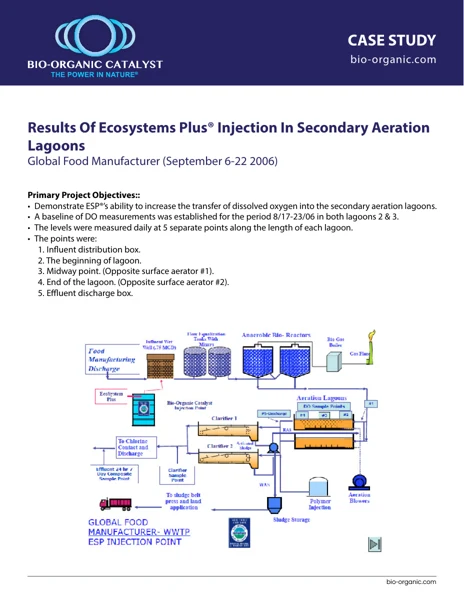
Food-Processing Wastewater — Secondary Aeration Lagoons

A 2006 food-manufacturing wastewater report on EcoSystem Plus in a paired-lagoon system. It tracks dissolved oxygen, COD, nutrients and dewatered sludge against historical baselines; shared return sludge prevented an isolated untreated-lagoon comparison.

Bio-Organic Catalyst · Field report · 7 pages

Download original PDF
Field report

Swine Lagoon Nutrient Reduction — Combined Treatment

A 12-month Nebraska swine-lagoon report evaluating EcoSystem Plus together with low-power aeration. Nutrient measurements and operator odor observations describe the combined program, not the product alone or a dairy-farm trial.

Bio-Organic Catalyst · Combined-treatment report · 7 pages

Download original PDF

References

Reference: EcoSystem Plus wastewater label.

Follow current product labels and site-specific application guidance. Results vary with operating conditions.

Discuss EcoSystem Plus for your site.

Tell us whether the priority is oxygen transfer, organic loading, FOG or sludge. Flow, load, solids and aeration records help us plan an EcoSystem Plus application and measure the response within your existing process.

Discuss an EcoSystem Plus application