Case Studies
Compare the conditions and measurements with your own operation; a reported result is a starting point for evaluation, not a promised outcome. Field studies and source summaries, organized by product. Each document keeps its original crop, site and formulation context. Not sure where to begin? Choose your industry or start with the operating problem, then compare the relevant product and source information.
Jump to your industry
Use each study’s setting, measurements and limitations to judge relevance. A field account, supplier presentation and controlled trial provide different kinds of evidence. Expand “Study at a glance” for a decision-focused summary; complete sources remain below.

Eco2 / ECO2MIX
Almonds2022–2023
Study at a glance
- Question studied
- Which soil biological and nutrient indicators were tracked under ECO2MIX-treated irrigation?
- Setting
- Almond soil samples, 2022–2023.
- Product or system
- ECO2MIX / carbonic-acid-treated irrigation water.
- Measured observation
- BeCrop biological indicators and Haney soil and nutrient measurements are presented across the reported sampling period.
- Limitations
- These soil measurements do not establish treatment-only causation or predict yield at another site; review sampling and comparison context.
Citrus2022–2023
Study at a glance
- Question studied
- Which soil biological and nutrient indicators were tracked under ECO2MIX-treated irrigation?
- Setting
- Citrus soil samples, 2022–2023.
- Product or system
- ECO2MIX / carbonic-acid-treated irrigation water.
- Measured observation
- BeCrop biological indicators and Haney soil and nutrient measurements are presented across the reported sampling period.
- Limitations
- These soil measurements do not establish treatment-only causation or predict yield at another site; review sampling and comparison context.
Pistachios2022–2023
Study at a glance
- Question studied
- Which soil biological and nutrient indicators were tracked under ECO2MIX-treated irrigation?
- Setting
- Pistachio soil samples, 2022–2023.
- Product or system
- ECO2MIX / carbonic-acid-treated irrigation water.
- Measured observation
- BeCrop biological indicators and Haney soil and nutrient measurements are presented across the reported sampling period.
- Limitations
- These soil measurements do not establish treatment-only causation or predict yield at another site; review sampling and comparison context.
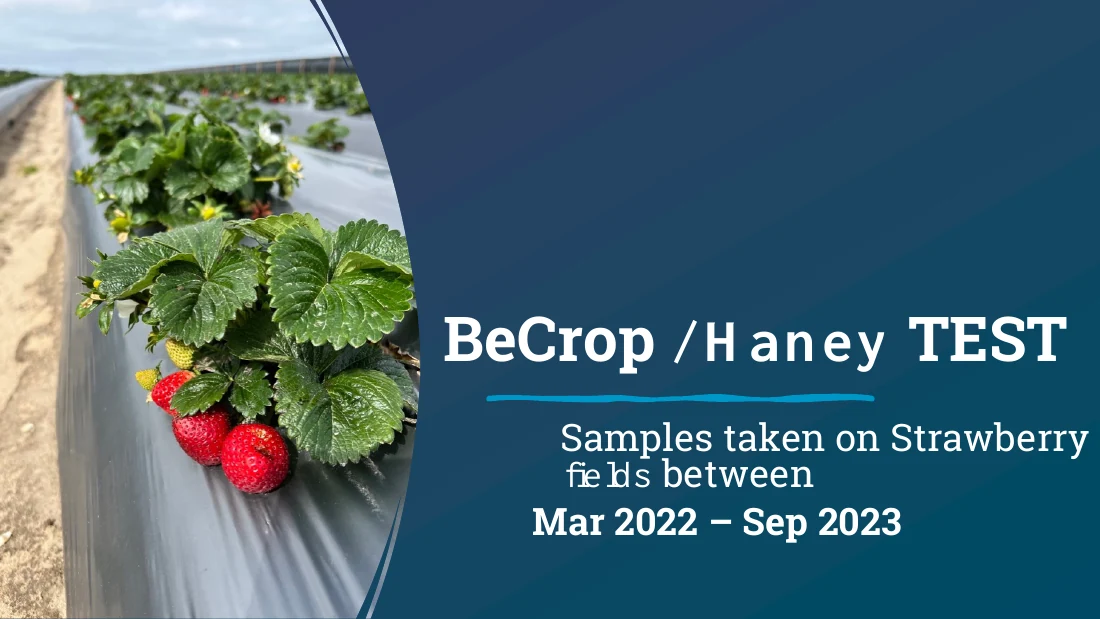
Strawberries
Study at a glance
- Question studied
- Which soil biological indicators were tracked in strawberry samples?
- Setting
- Strawberry samples; source dates require clarification.
- Product or system
- ECO2MIX / carbonic-acid-treated irrigation water.
- Measured observation
- BeCrop microbial and soil-function indicators are shown across sample dates.
- Limitations
- The opening title and later charts disagree on the end date. Biological indicators are not direct yield or disease measurements.
Citrus (Tangerine files)August–December 2024
Study at a glance
- Question studied
- Which biological, nutrient and salinity indicators were tracked in the retained tangerine report set?
- Setting
- Citrus samples, August–December 2024; retained files are named Tangerine.
- Product or system
- ECO2MIX / carbonic-acid-treated irrigation water.
- Measured observation
- BeCrop biological indicators and Haney soil, nutrient and electrical-conductivity measurements are presented.
- Limitations
- The source title says Citrus; file naming alone does not establish a more specific crop. Soil indicators do not establish transferable crop response.
TomatoesMarch–July 2024
Study at a glance
- Question studied
- Which soil biological and nutrient indicators were tracked under ECO2MIX-treated irrigation?
- Setting
- Tomato soil samples, March–July 2024.
- Product or system
- ECO2MIX / carbonic-acid-treated irrigation water.
- Measured observation
- BeCrop biological indicators and Haney soil and nutrient measurements are presented across the reported sampling period.
- Limitations
- These soil measurements do not establish treatment-only causation or predict yield at another site; review sampling and comparison context.
Turfgrass
Study at a glance
- Question studied
- Which soil biological and nutrient indicators were tracked in turfgrass samples?
- Setting
- Turfgrass: BeCrop March 2022–September 2023; Haney April 2021–September 2023.
- Product or system
- ECO2MIX / carbonic-acid-treated irrigation water.
- Measured observation
- Reports track microbial indicators, soil nutrients and organic carbon-to-nitrogen ratio.
- Limitations
- Different reports cover different periods. Soil measurements are not direct playing-quality or disease results and do not isolate treatment-only effects.

Living Water / Applied Organic Solutions
- Living Water — 2025 Cross-Crop Impact SummaryPDF · 10 pages · 21.6 MB (opens in a new tab)
Living Water’s 2025 summary of soil biology, plant measurements and field observations across multiple crops, including barley, pistachios, alfalfa, cotton, blueberries and garlic.
Download PDFStudy at a glance
- Question studied
- What field observations were reported across crops using Living Water?
- Setting
- Supplier compilation across barley, pistachio, alfalfa, cotton, blueberry and garlic in 2025.
- Product or system
- Living Water microbial inputs.
- Measured observation
- The compilation presents soil biology, plant measurements and crop-specific field, yield, quality and cost observations.
- Limitations
- This mixes settings and evidence types rather than a uniform controlled trial; reported returns or savings are not transferable predictions.
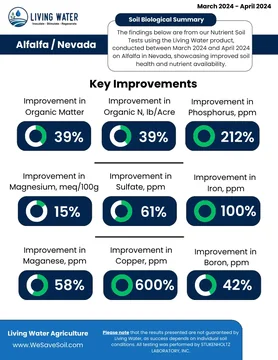
- Alfalfa soil and nutrient summary — Nevada, March–April 2024
Study at a glance
- Question studied
- How did two soil-test readings differ during the reported alfalfa evaluation?
- Setting
- Nevada alfalfa, March–April 2024; supplier summary referencing Stukenholtz laboratory.
- Product or system
- Living Water microbial inputs.
- Measured observation
- Reported organic matter changed from 1.65% to 2.29%, phosphorus from 16 to 50 ppm, and salts from 1.4 to 1.9 mmhos/cm.
- Limitations
- No untreated control is identified; two-date differences do not isolate product effects. Review the full table, including increased salts.
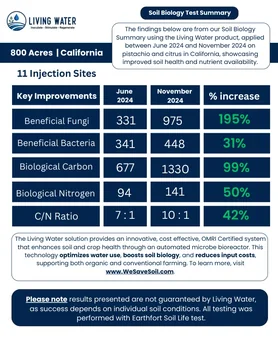
- Soil biology summary — California, June–November 2024
Study at a glance
- Question studied
- Which biological readings were reported across the California evaluation?
- Setting
- Pistachio and citrus, June–November 2024; 800 acres and 11 injection sites.
- Product or system
- Living Water microbial inputs.
- Measured observation
- The summary reports fungi readings of 331 to 975 and bacteria readings of 341 to 448.
- Limitations
- Displayed biological values lack units, and no untreated control is identified. Request underlying laboratory reports before comparing sites.

Kula Bio
- Kula Bio Strawberry Technical Trial Data
Study at a glance
- Question studied
- How did strawberry yield and berry measurements compare under full and reduced fertility programs?
- Setting
- California Santa Maria 2023–2024 organic trial and Florida Thonotosassa 2024–2025 conventional trial.
- Product or system
- Kula-N in California; Kula-Next in Florida.
- Measured observation
- The deck compares counts and yield or weight under full and reduced fertility. California full-program berry weight is charted as 64,895 lb/ac for control and 66,393 lb/ac with Kula-N.
- Limitations
- Locations, formulations and fertility programs differ. Florida reduced-program summaries conflict with chart comparisons; do not promise reduced-nitrogen performance or ROI.
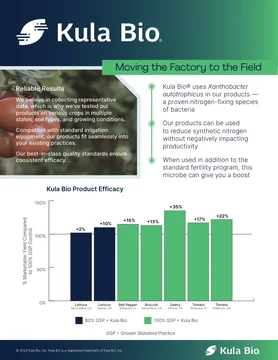
- Kula Bio Vegetable Trial Summary
Study at a glance
- Question studied
- What marketable-yield comparisons were reported across vegetable trials?
- Setting
- Supplier summary of lettuce, pepper, broccoli, celery and tomato trials in California and Florida; copyright 2024.
- Product or system
- Kula Bio input; specific formulation is not identified in the sheet.
- Measured observation
- The chart reports marketable-yield differences of +2% to +35% relative to the 100% grower-standard-practice control, with 80% and 100% fertility-plus-Kula groups distinguished.
- Limitations
- The one-page summary does not provide full protocols or statistical analysis; crops, sites and fertility programs are not interchangeable.


Bio-Organic Catalyst
Agriculture
White papers, field reports, presentations and observations for agricultural applications. Study designs and publication types differ; these resources do not establish the same result in another setting. Follow current product labels for application decisions.
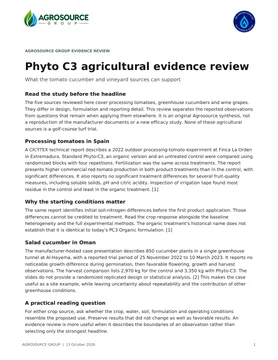
- Agrosource Group — Phyto-C3 Agricultural Evidence Review
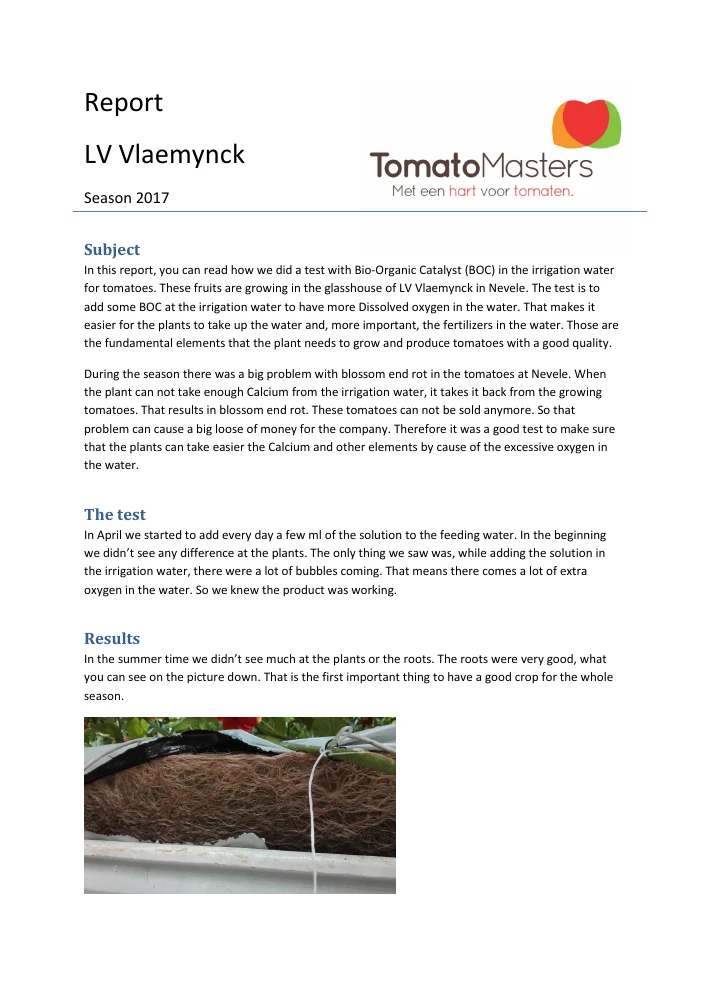
- LV Vlaemynck Tomato Irrigation Report — 2017Grower report · PDF · 3 pages · 0.6 MB (opens in a new tab)
A greenhouse tomato grower’s account from Nevele, Belgium, discussing irrigation-water treatment, root observations and blossom-end rot during the 2017 season.
Download PDFStudy at a glance
- Question studied
- How was irrigation-water treatment described by a tomato grower?
- Setting
- Nevele, Belgium; greenhouse tomatoes, 2017
- Product or system
- Phyto-C3, as identified in the source
- Measured observation
- Root observations and blossom-end rot are discussed.
- Limitations
- Grower account, not a controlled comparison.
- Verification of Agronomic Effects of Phyto-C3 — CICYTEX, 2022Field-trial report · PDF · 32 pages · 1.8 MB (opens in a new tab)
CICYTEX technical report on an outdoor processing-tomato trial, comparing formulations and a control, with crop, soil, water and irrigation-system measurements.
Download PDFStudy at a glance
- Question studied
- What agronomic and irrigation responses were measured?
- Setting
- CICYTEX outdoor processing tomatoes, 2022
- Product or system
- Phyto-C3 formulations and control
- Measured observation
- Crop, soil, water and irrigation-system measurements were compared.
- Limitations
- Read formulation-specific treatments and controls; do not transfer a result to a different formulation or crop.
- Phyto-C3 in Hydroponic Salanova Lettuce — IsraelCase-study presentation · PDF · 9 pages · 0.5 MB (opens in a new tab)
A presentation on a 2020 Israeli hydroponic lettuce trial, comparing treated and untreated ponds and observations during crop development.
Download PDFStudy at a glance
- Question studied
- How did treated and untreated hydroponic ponds compare?
- Setting
- Salanova lettuce, Israel, 2020
- Product or system
- Phyto-C3
- Measured observation
- The presentation compares treated and untreated ponds during crop development.
- Limitations
- Case-study presentation; treatment and site conditions matter.
- Agriculture Case Study — Salad Cucumber, OmanCase-study presentation · PDF · 9 pages · 3.8 MB (opens in a new tab)
Presentation describing a 106-day greenhouse salad-cucumber trial at Al-Hayema, Oman, from November 2022 to March 2023.
Download PDFStudy at a glance
- Question studied
- What was observed during a greenhouse cucumber program?
- Setting
- Al-Hayema, Oman; 106 days, November 2022–March 2023
- Product or system
- Product and treatment details in the Phyto-C3 case-study source
- Measured observation
- The source records greenhouse salad-cucumber observations over the stated trial period.
- Limitations
- Presentation evidence; inspect its methods and comparison conditions before applying the findings elsewhere.
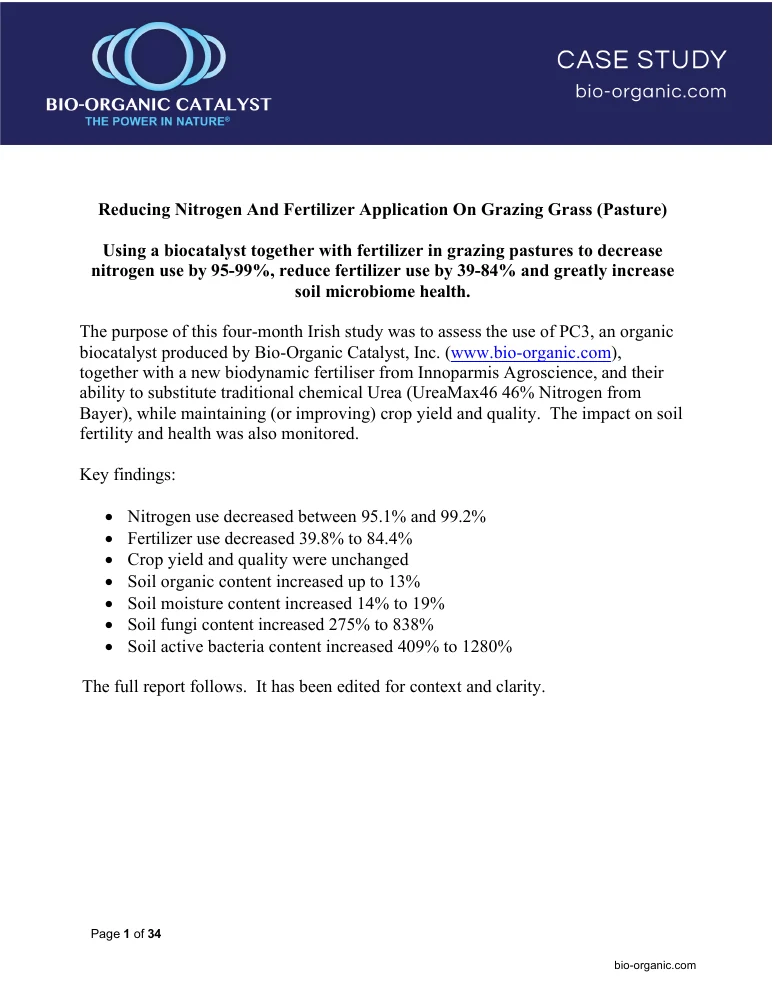
- Reducing Nitrogen and Fertilizer Application on Grazing Grass — IrelandTrial report with Bio-Organic Catalyst summary · PDF · 34 pages · 4.4 MB (opens in a new tab)
Report on a September–December 2022 pasture trial in Tinahely, combining PC3 with an Innoparmis fertilizer. Includes a Bio-Organic Catalyst summary.
Download PDFStudy at a glance
- Question studied
- What did the pasture fertilizer-reduction trial report?
- Setting
- Tinahely, Ireland; September–December 2022
- Product or system
- PC3 combined with an Innoparmis fertilizer
- Measured observation
- The report examines nitrogen/fertilizer application in grazing grass.
- Limitations
- Combined program; the report and supplier summary are distinct and do not isolate every input’s effect.
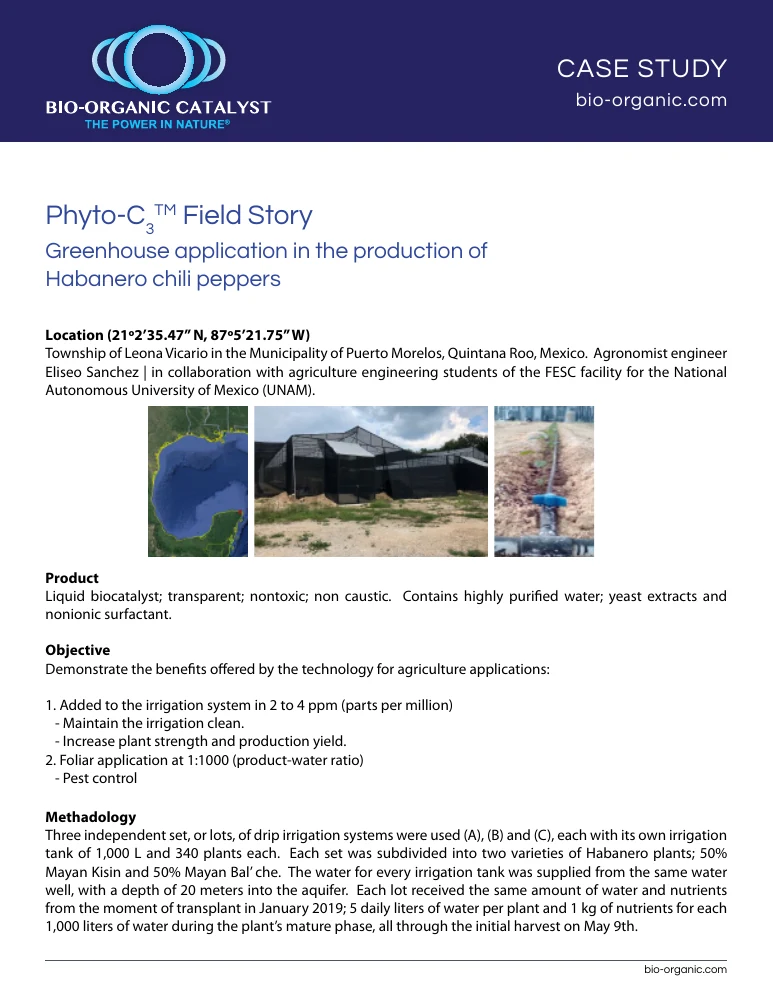
- Phyto-C3 Field Story — Greenhouse Habanero Chili PeppersField-story case study · PDF · 7 pages · 0.8 MB (opens in a new tab)
A 2019 greenhouse account from Quintana Roo, Mexico, comparing irrigation treatments and a control in two habanero varieties.
Download PDFStudy at a glance
- Question studied
- How did irrigation treatments compare in habanero peppers?
- Setting
- Quintana Roo, Mexico; greenhouse, 2019
- Product or system
- Phyto-C3 treatments and control
- Measured observation
- The account compares irrigation treatments in two habanero varieties.
- Limitations
- Field story; retain variety and treatment differences rather than assuming one transferable response.
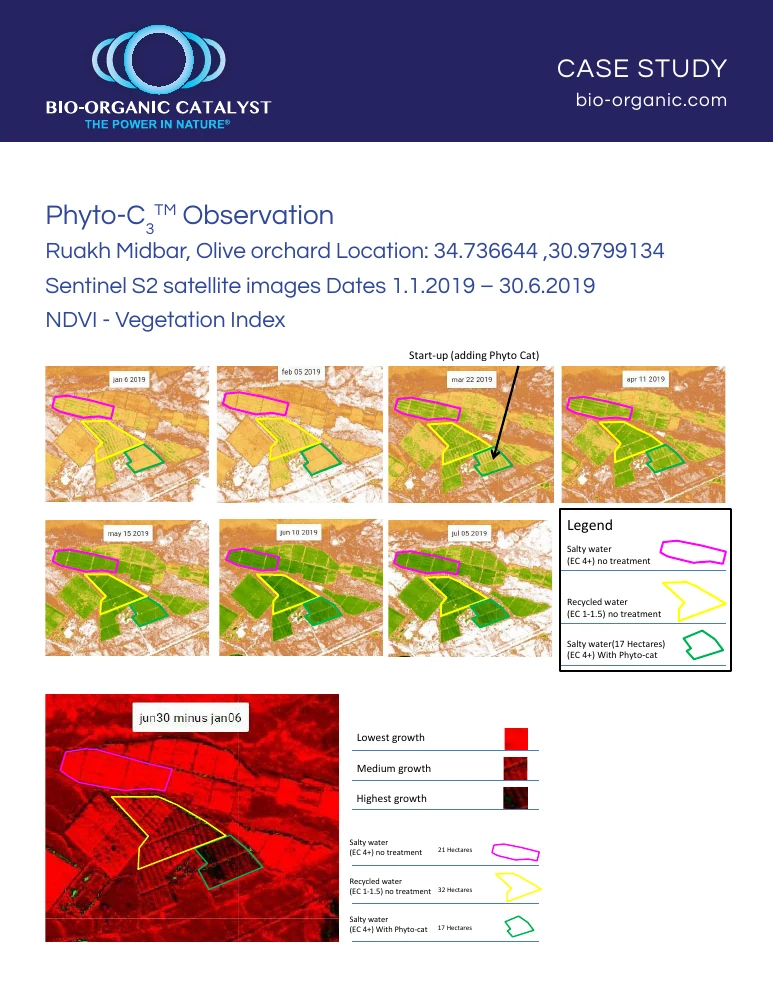
- Phyto-C3 Observation — Ruakh Midbar Olive OrchardObservational case study · PDF · 2 pages · 0.8 MB (opens in a new tab)
Satellite vegetation-index imagery and orchard photographs comparing areas with different water sources and treatment conditions in 2019.
Download PDFStudy at a glance
- Question studied
- What differences appeared in orchard imagery?
- Setting
- Ruakh Midbar olive orchard, 2019
- Product or system
- Phyto-C3 application context
- Measured observation
- Satellite vegetation-index imagery and photographs compare areas.
- Limitations
- Water sources and treatment conditions differed; imagery alone does not isolate a product effect.
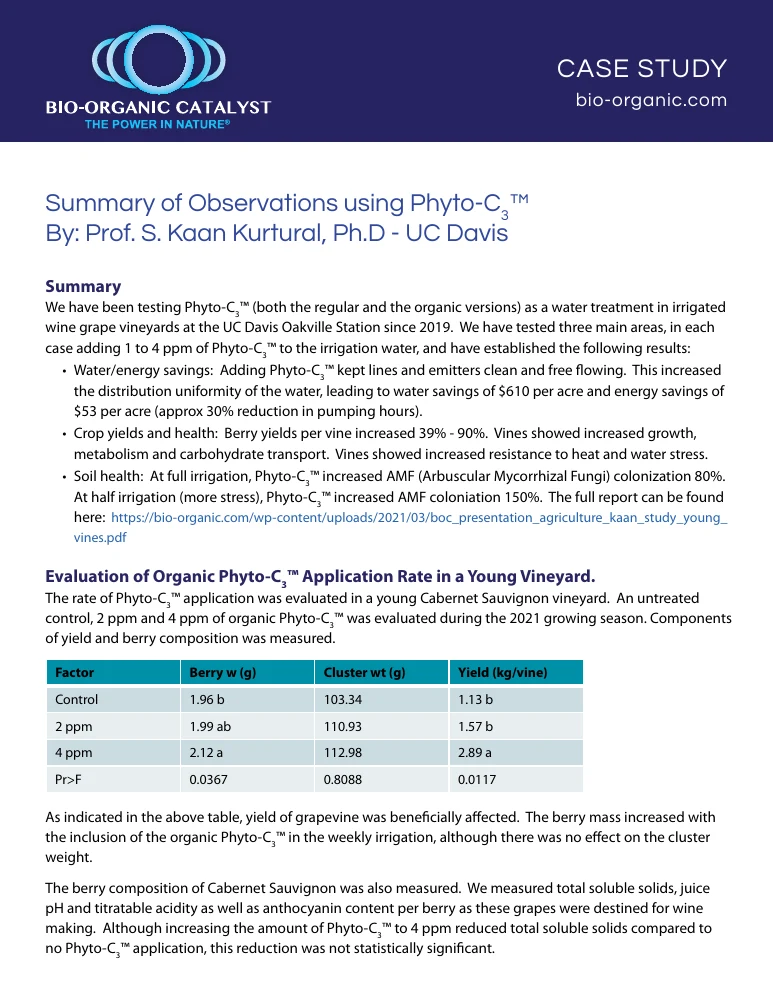
- Summary of Observations Using Phyto-C3 — S. Kaan KurturalResearch-observation summary · PDF · 5 pages · 0.1 MB (opens in a new tab)
Summary attributed to Prof. S. Kaan Kurtural, Ph.D., UC Davis, covering irrigated wine-grape work at Oakville Station, including formulation, crop and soil observations.
Download PDFStudy at a glance
- Question studied
- What crop and soil observations were reported?
- Setting
- Oakville Station irrigated wine grapes
- Product or system
- Phyto-C3 formulations
- Measured observation
- The summary records formulation, crop and soil observations.
- Limitations
- Research-observation summary, not a guarantee or proof of equivalent response across formulations.
Composting
Poultry-residue processing and crop-residue odor sources, kept in their original product and process context. A described processing period is not a promised cycle time.
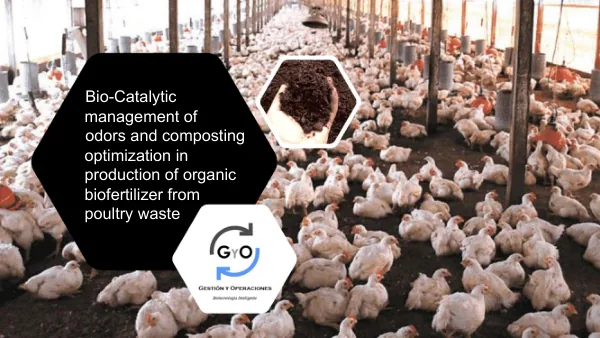
- Poultry-Residue Composting & Biofertilizer: GyOProcess presentation · PDF · 6 pages · 2.6 MB (opens in a new tab)
GyO describes a 45-day process for poultry excreta and residues using a biocatalyst, bacterial consortia and added substrates. No specific BOC formulation, trial site or study date is identified. The presentation does not provide a controlled comparison or quantified evidence of faster composting or odor reduction.
Download PDFStudy at a glance
- Question studied
- How is the poultry-residue process described?
- Setting
- Poultry excreta and residue processing; site/date not identified
- Product or system
- Biocatalyst, bacterial consortia and added substrates; specific BOC formulation not identified
- Measured observation
- A 45-day process is described.
- Limitations
- No controlled comparison or quantified faster-composting or odor-reduction evidence.
- Moscow-Region Crop-Residue Odor Pilot: EcoSystem Plus, 2015Observational container pilot · PDF · 4 pages · 0.3 MB (opens in a new tab)
A two-container lettuce and arugula residue pilot at JSC Agricultural Complex Moscowskiy reported odor improvement after EcoSystem Plus treatment. The report found no observed acceleration of composting or reduction in residue weight or volume. Odor observations were not instrumental gas measurements.
Download PDFStudy at a glance
- Question studied
- Did the residue pilot show odor or composting changes?
- Setting
- Two-container lettuce/arugula residue pilot, Moscow region, 2015
- Product or system
- EcoSystem Plus
- Measured observation
- Odor improvement was reported; no observed acceleration of composting or reduction in weight/volume.
- Limitations
- Odor observations were not instrumental gas measurements.
Dairy & Livestock Lagoons
Reports from livestock and dairy-processing wastewater applications. The swine-lagoon and creamery reports involve different waste streams from dairy-manure lagoons.
- Swine Lagoon Nutrient Reduction — Bio-Organic Catalyst & Low-Power AerationCombined-treatment report · PDF · 7 pages · 2.4 MB (opens in a new tab)
A 12-month Nebraska swine-lagoon report comparing EcoSystem Plus combined with low-power aeration against an untreated lagoon at a nearby facility. Includes nutrient measurements and operator odor observations; the combined treatment is not a dairy-farm trial.
Download PDFStudy at a glance
- Question studied
- What changed during combined lagoon treatment?
- Setting
- Nebraska swine lagoons; 12-month report
- Product or system
- EcoSystem Plus with low-power aeration
- Measured observation
- Nutrient measurements and operator odor observations are reported.
- Limitations
- Nearby untreated lagoon comparison and combined treatment; not a dairy-manure trial.
- Texas Creamery Wastewater — Eco-Cat & Aerated LagoonsProcessing-wastewater report · PDF · 7 pages · 2.6 MB (opens in a new tab)
A 2007 butter-processing wastewater report on Eco-Cat dosing into sequencing batch reactors feeding aerated lagoons. Compares dissolved oxygen, organic loading and suspended solids with an earlier baseline; this is processing wastewater, not dairy-manure lagoon evidence.
Download PDFStudy at a glance
- Question studied
- What changed in creamery wastewater treatment?
- Setting
- Texas butter-processing wastewater, 2007
- Product or system
- Eco-Cat; sequencing batch reactors feeding aerated lagoons
- Measured observation
- Dissolved oxygen, organic loading and suspended solids are compared with an earlier baseline.
- Limitations
- Processing wastewater, not dairy-manure evidence; before/after comparison.
Ponds & Reservoirs
Lake and water-body reports describing their original applications, observations and study limitations.
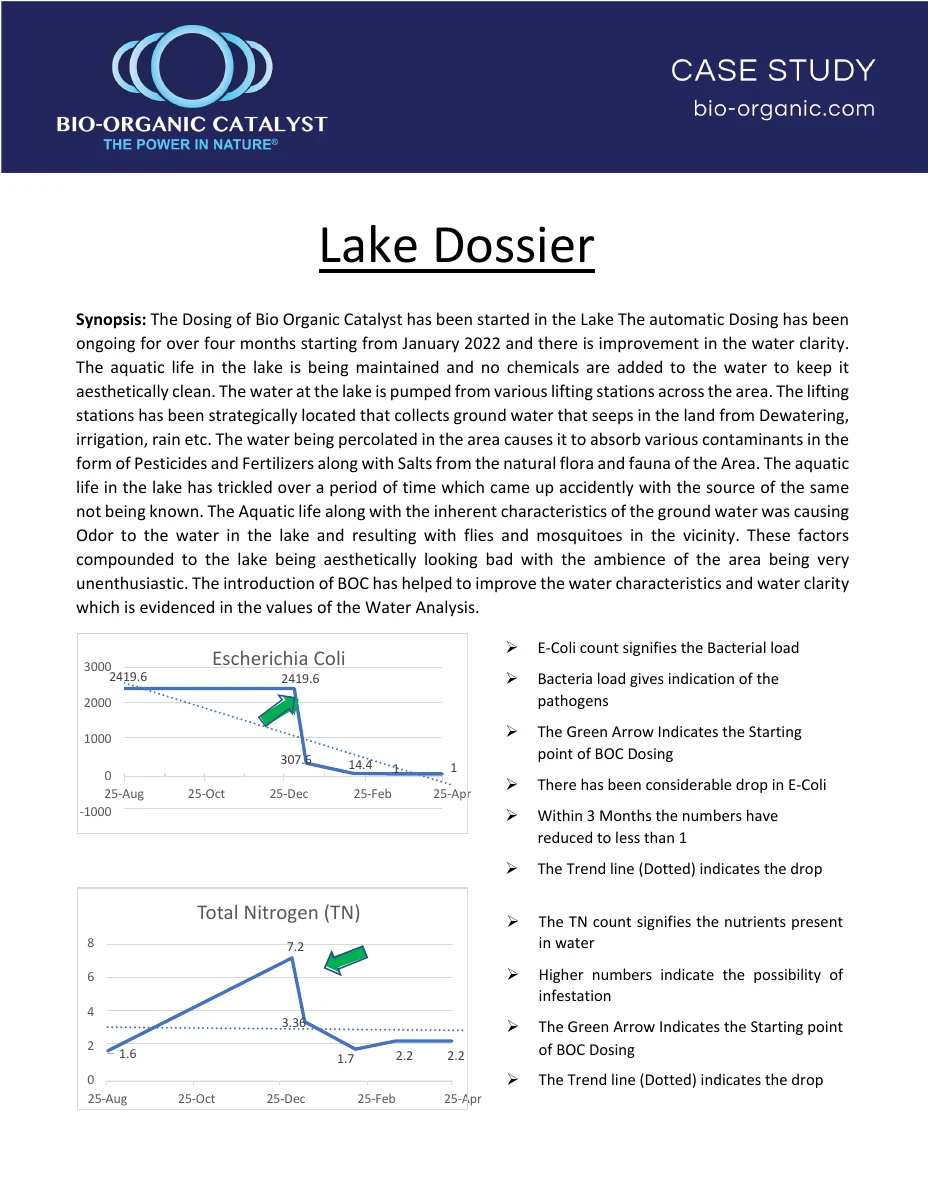
- Lake Dossier, Water ClarityObservational lake report · PDF · 3 pages · 1.8 MB (opens in a new tab)
A Bio Catalyst Middle East lake report presenting water-quality observations before and during Bio-Organic Catalyst dosing, from August 2021 to April 2022. Includes water-analysis results and reported clarity observations; it is not a controlled reservoir or biofilm trial.
Download PDFStudy at a glance
- Question studied
- What water-quality and clarity changes were reported?
- Setting
- Lake report; August 2021–April 2022
- Product or system
- Bio-Organic Catalyst dosing; consult source for formulation details
- Measured observation
- Water-analysis results and clarity observations before/during dosing.
- Limitations
- Not a controlled reservoir or biofilm trial.
Wastewater Facilities & Lift Stations
Field accounts and monitoring reports for sewage treatment, collection systems and lift stations. Each source retains its actual product, site and comparison conditions. Odor reduction does not establish safe gas levels; retain gas monitoring and facility safety controls.
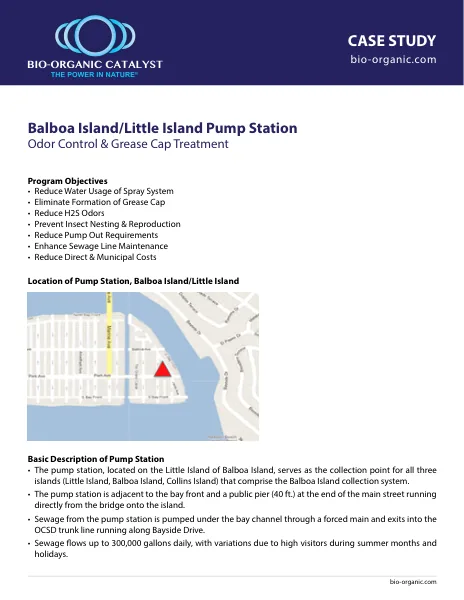
- Balboa Island / Little Island Pump Station: EcoSystem Plus, 2013Combined-system case study · PDF · 3 pages · 0.6 MB (opens in a new tab)
A 2013 pump-station report documenting EcoSystem Plus dosing together with circulation, aeration and spray-cycle changes. Reports reduced grease-cap formation and spray-water use, with H₂S logger readings. Results describe the combined installation rather than the effect of the product alone.
Download PDFStudy at a glance
- Question studied
- What did the combined pump-station changes achieve?
- Setting
- Balboa/Little Island pump station, 2013
- Product or system
- EcoSystem Plus plus circulation, aeration and spray-cycle changes
- Measured observation
- Reduced grease-cap formation and spray-water use, with H₂S logger readings.
- Limitations
- Combined installation, not product-only causation; odor reduction does not establish safe gas exposure.
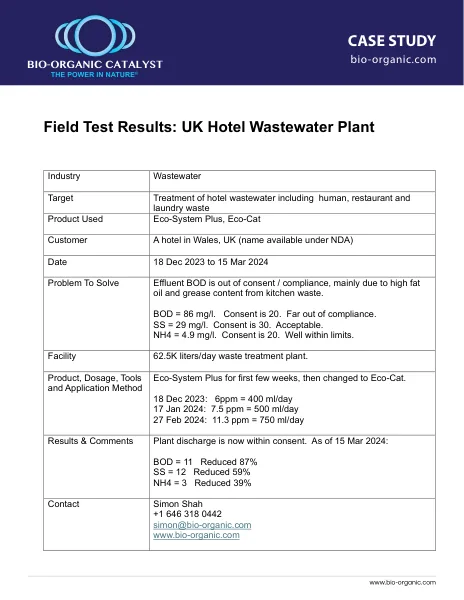
- UK Hotel Wastewater Plant: EcoSystem Plus & Eco-Cat, 2023–2024Field-test report · External PDF at bio-organic.com · 9 pages · 2.3 MB (opens in a new tab)
A December 2023–March 2024 report from an unnamed hotel plant in Wales. EcoSystem Plus was followed by Eco-Cat, with dose and loading changes. Reported BOD fell from 86 to 11 mg/L; the before-and-after account does not isolate product effects or establish compliance at another facility.
Open source PDF to downloadStudy at a glance
- Question studied
- How did plant BOD change during the program?
- Setting
- Unnamed hotel plant, Wales; December 2023–March 2024
- Product or system
- EcoSystem Plus followed by Eco-Cat
- Measured observation
- Reported BOD fell from 86 to 11 mg/L.
- Limitations
- Dose/loading changed; uncontrolled before/after account does not establish compliance at another site.
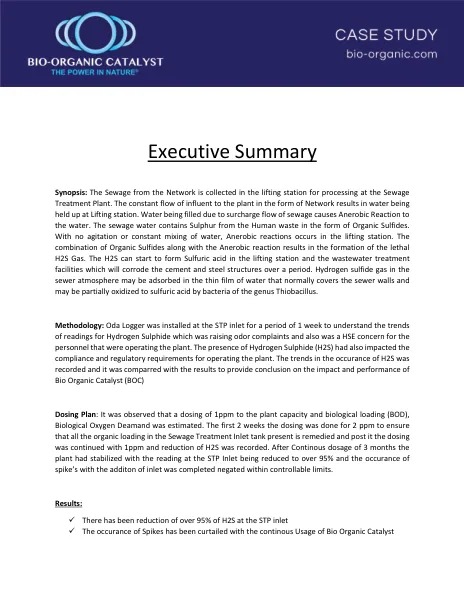
- Pumping Station & Sewage-Treatment Inlet: H₂S Trends, 2022Monitoring report · External PDF at bio-organic.com · 5 pages · 3.0 MB (opens in a new tab)
Bio Catalyst Middle East compares H₂S logger readings before and during BOC dosing at a pumping station and treatment-plant inlet, using June–November 2022 data. The source does not identify the facility or specific product formulation. This uncontrolled comparison is not an exposure-safety assessment.
Open source PDF to downloadStudy at a glance
- Question studied
- How did H₂S logger readings change during dosing?
- Setting
- Pumping station and treatment inlet; June–November 2022
- Product or system
- BOC; specific formulation not identified
- Measured observation
- The report compares logger readings before and during dosing.
- Limitations
- Facility not named; uncontrolled comparison is not an exposure-safety assessment.
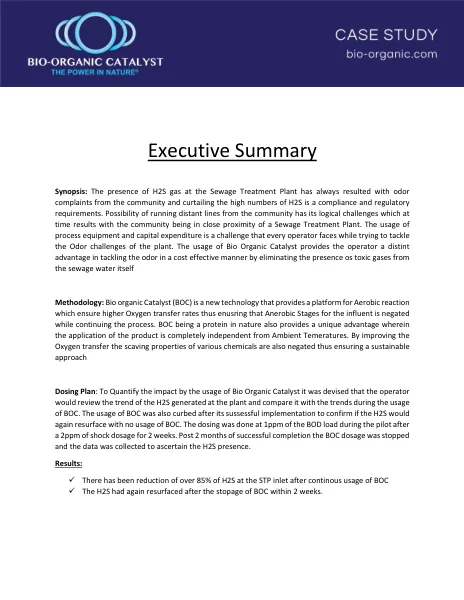
- Sewage-Treatment Inlet: BOC Odor-Control MonitoringMonitoring report · External PDF at bio-organic.com · 2 pages · 1.6 MB (opens in a new tab)
An undated Bio Catalyst Middle East report showing inlet H₂S trends before, during and after a BOC dosing program. It reports lower readings during dosing and a rebound after dosing stopped. The facility and specific formulation are not named; the report does not establish safe gas exposure.
Open source PDF to downloadStudy at a glance
- Question studied
- What happened to H₂S readings during and after dosing?
- Setting
- Sewage-treatment inlet; undated report
- Product or system
- BOC; specific formulation not identified
- Measured observation
- Lower readings during dosing and a rebound after dosing stopped are reported.
- Limitations
- Facility not named; readings do not establish safe gas exposure.
Winery & Food Processing Solutions
Food-processing wastewater reports covering specific waste streams, equipment and comparison conditions. These are not winery-specific trials.
- Texas Creamery Wastewater — Eco-Cat & Aerated LagoonsProcessing-wastewater report · PDF · 7 pages · 2.6 MB (opens in a new tab)
A 2007 butter-processing wastewater report on Eco-Cat dosing into sequencing batch reactors feeding aerated lagoons. Compares dissolved oxygen, organic loading and suspended solids with an earlier baseline; this is processing wastewater, not dairy-manure lagoon evidence.
Download PDFStudy at a glance
- Question studied
- What changed in creamery wastewater treatment?
- Setting
- Texas butter-processing wastewater, 2007
- Product or system
- Eco-Cat; sequencing batch reactors feeding aerated lagoons
- Measured observation
- Dissolved oxygen, organic loading and suspended solids are compared with an earlier baseline.
- Limitations
- Processing wastewater, not dairy-manure evidence; before/after comparison.
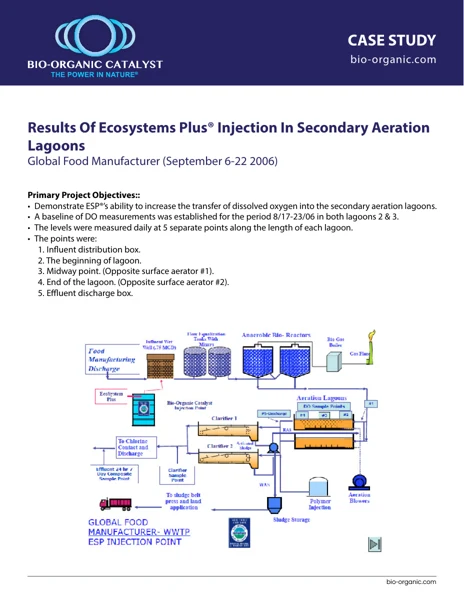
- Food-Processing Wastewater — EcoSystem Plus in Secondary Aeration LagoonsFood-processing lagoon report · PDF · 7 pages · 1.3 MB (opens in a new tab)
A 2006 food-manufacturing wastewater report on EcoSystem Plus injection in a paired-lagoon treatment system. Tracks dissolved oxygen, COD, nutrients and dewatered sludge against historical baselines; shared return sludge prevented an isolated untreated-lagoon comparison.
Download PDFStudy at a glance
- Question studied
- What did the lagoon treatment report track?
- Setting
- Food-manufacturing paired-lagoon system, 2006
- Product or system
- EcoSystem Plus
- Measured observation
- Dissolved oxygen, COD, nutrients and dewatered sludge against historical baselines.
- Limitations
- Shared return sludge prevented an isolated untreated-lagoon comparison; not a winery trial.