Ask about Eccomate
Request Eccomate availability and application information. Follow the current label and your facility’s operating requirements.
Request product information

Target organic odors where waste is handled. Eccomate targets organic odors in compost, food waste, biosolids and other waste-handling areas. Spray and misting applications deliver the product to the odor source for organic-odor and VOC control.
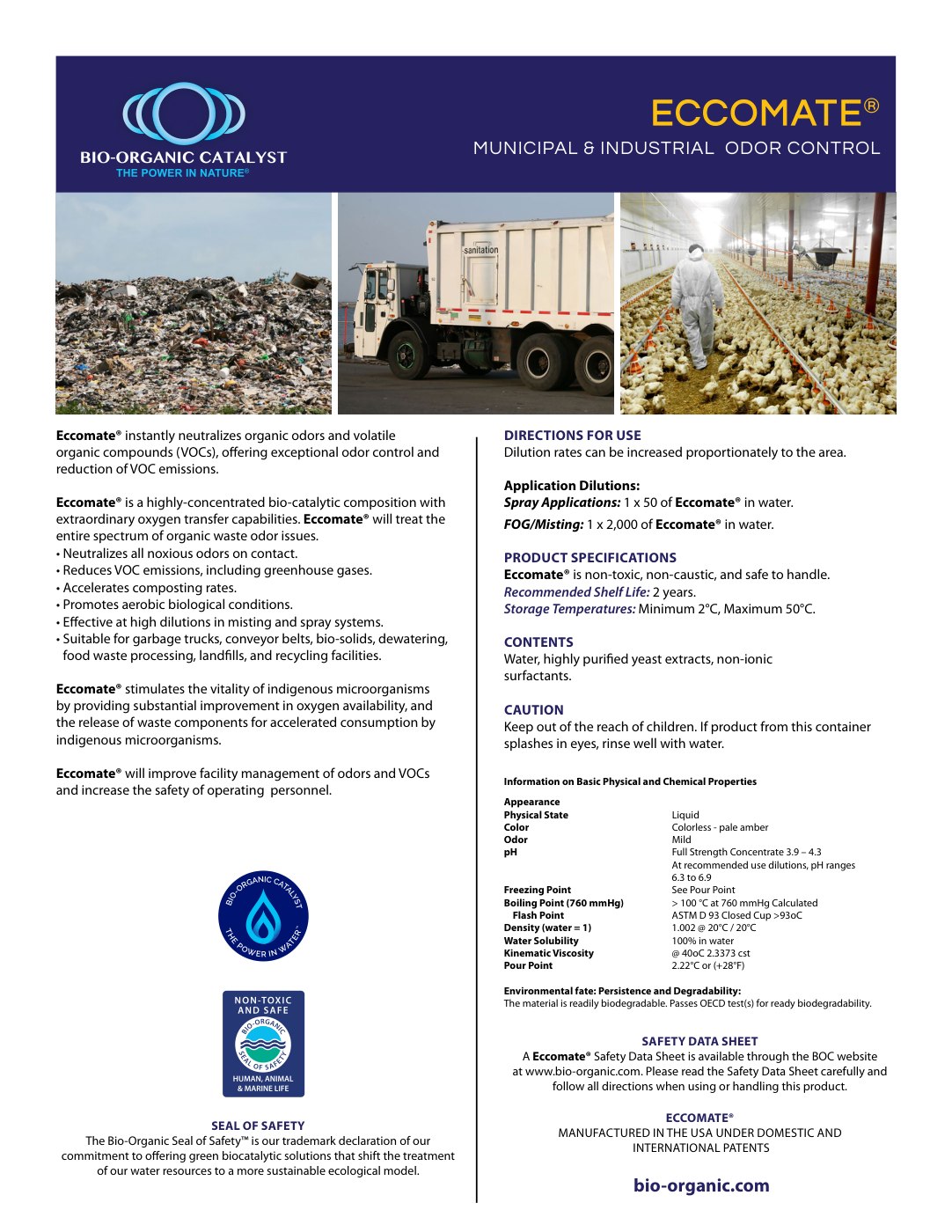
Eccomate controls organic odors in municipal and industrial waste operations, including biosolids, dewatering, food-waste processing, conveyors and other waste-handling areas.
Odor assessment should identify where emissions originate, when they occur and how material is handled. Worker exposure and process controls must be reviewed separately from perceived odor.
Agrosource Group matches Eccomate spray or misting delivery to the material, handling step and odor source. Record operating conditions and odor observations to check the response while maintaining the facility’s exposure controls.
Include source access, delivery equipment and staff time in the plan. Agree on where and when to record odor observations so a purchasing decision can be revisited against actual operating conditions.
Apply Eccomate at organic odor sources in garbage trucks, conveyors, biosolids, dewatering, food-waste processing, landfills and recycling facilities. Maintain waste removal, ventilation and other process controls.
For composting and municipal operations, map the source and timing of odors rather than treating the entire facility as one uniform application.
Use diluted spray or fog/misting delivery. Select equipment and placement for the odor-generating step, accounting for material handling, wind, enclosures and worker exposure.
Record operating conditions with odor observations. Changes in feedstock, weather, storage time and handling practices can affect the result and should be considered when reviewing performance.
The manufacturer's container label lists garbage trucks, conveyor belts, biosolids handling and dewatering, food-waste processing, landfills and recycling facilities. It gives separate dilution directions for spray and fogging or misting systems. Match coverage to the odor source and follow the container label and site exposure controls.
Product composition and use requirements. Follow the current label for application directions.
Explore product options, current labels and application directions for your system.
Request Eccomate availability and application information. Follow the current label and your facility’s operating requirements.
Request product informationEccomate targets municipal and industrial odors, including waste-handling surfaces and areas. Wastewater treatment and sludge-processing objectives may call for a different BOC product.
No. Odor improvement does not establish that hazardous-gas or other worker exposures are controlled.
Read the technology overview alongside Eccomate’s odor-management application. Odor observations do not replace hazardous-gas monitoring or worker protection.
Product labels, application guidance, publications and selected videos.
An Eccomate application example from poultry operations; results from other settings depend on the material, application and operating conditions.
Eccomate
Bio-Organic Catalyst
References: Eccomate product sheet and Bio-Organic Catalyst product information.
Follow current product labels and site-specific application guidance. Results vary with operating conditions.
Describe the material being handled, where odors arise and when they are most noticeable. We can review Eccomate’s application fit while keeping worker-exposure controls and site operating requirements in place.