
Bio-Organic Catalyst Technology
 Bio-Organic Catalyst (BOC) products are liquid formulations for water, wastewater and cleaning applications. They work with existing microorganisms rather than adding a bacterial inoculum. Safety and handling requirements depend on the product and concentration. Follow the current label and safety data sheet; Eco-Cat’s June 2025 SDS notes mild skin and eye irritation.
BOC formulations combine fermentation-derived ingredients with surface-active components. They help make organic material more accessible to existing microorganisms and support biological treatment in suitable systems.
Surface-active molecules have water-attracting and water-repelling regions. This helps water interact with oils and other organic material that resist mixing. Product selection depends on the treatment need:
- Fats, oils and grease
- Organic loading and accumulated solids
- Oxygen transfer in aerated treatment
- Organic odors
- Organic surface film and fouling
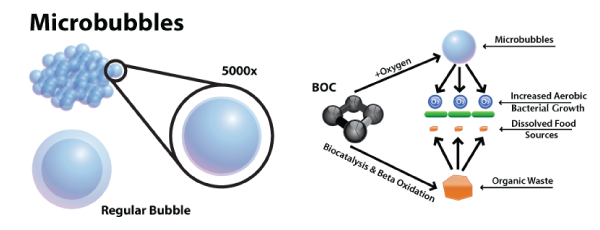
In aerated systems, oxygen transfer depends on bubble size, mixing, available oxygen and wastewater conditions. Products intended for these applications support oxygen transfer as part of the treatment process; they do not generate oxygen or replace required aeration.
Eco-Cat supports FOG treatment, organic-solids processing and associated odor control in wastewater and collection systems. EcoSystem Plus supports oxygen transfer and organic-waste processing in aerobic treatment, and organic-solids conversion in anaerobic digestion. Eccomate targets localized organic odors through spray or mist application.
Fats, oils and grease can accumulate in drains, collection systems and treatment units. Eco-Cat and EcoSystem Plus support their solubilization and biological processing where the product label and treatment stage are appropriate. Loading, contact time, temperature, aeration and solids management remain part of the operating plan.
Match the formulation to the process and monitor the operating result. Clear-Cat addresses organic loading and biological film in suitable non-potable ponds and reservoirs, while Phyto-C3 and PC3 Organic have separate irrigation and soil-conditioning roles. Follow the exact product label and retain required aeration, maintenance and safety controls.
Literature
Literature · Bio-Organic Catalyst presentation · 16 pages
Water & Waste Treatment — BOC Presentation
An overview of Bio-Organic Catalyst technology and water/waste applications, including animal waste, food processing and water bodies. This presentation is not a pond or dairy field trial and does not establish site-specific performance.
- Research Article: Effectiveness of a bio-catalytic agent used in the bioremediation of crude oil-polluted seawater
- BOC ESP Testing – Summary of Results
- BOC ESP Testing – Summary of Results, Part 2
- UC Irvine: Indigenous Bacterial Growth Study
- Orange County, CA Sanitation District, Dissolved Oxygen Increase from Open Air